Compare

Your own branded platform vs delivery marketplaces

Just Eat and Wolt are marketplaces, not ordering platforms you own. Your restaurant is one listing among many, in their app, under their brand, in an ordering flow that is the same for every restaurant on it. They bring new guests and couriers, and take a commission on every order. FastFoodShop is your own branded platform: your web shop, app and kiosk, set up the way your chain works.

The short version

A delivery marketplace is the right tool for
  • •Reaching guests who do not know you yet and browse the marketplace first.
  • •Delivery to the door, with couriers and tracking that you do not run.
  • •Testing a new area before you put money into it.
Your own branded platform is the right tool for
  • ✓Orders from guests who already know you, without a commission on each one.
  • ✓Knowing your guests and keeping them, with your own loyalty program.
  • ✓Running your brand, menu, deals and upsell the way your chain works, not the way a marketplace allows.
  • ✓Ordering inside the restaurant, at the kiosk or in the app. Platforms do not serve that.

Side by side

The same order, placed through a delivery marketplace or through your own platform.

What mattersDelivery marketplaceYour own platform (FastFoodShop)
Whose brand the guest seesThe marketplace's. You are one listing in their app, next to your competitors.Yours: the web shop on your domain, your own app in the app stores, your kiosk, in your design.
How your menu worksThe marketplace's menu format, the same for every restaurant on it.Your structure: meal deals with swappable components, paid upgrades, add-ons and removals.
Deals and pricesWithin the promotion tools the marketplace offers.By restaurant, weekday, time window, channel, order type or customer type. Prices per restaurant.
Cost per orderA commission on every order, set in your contract with the platform.No marketplace commission on the order. FastFoodShop has its own cost; ask us for the figure for your chain.
Who owns the guestThe marketplace. The guest has an account with them and sees your competitors next to you.You. The guest orders in your shop, under your brand, and can join your loyalty program.
Order dataWhat the marketplace chooses to share with you.Every order, every restaurant, every channel, in your back office and in feeds to your BI.
LoyaltyThe marketplace's own program, if it has one. It rewards ordering on the marketplace.Your program: points, punch cards, vouchers, or a paid subscription like SunsetPLUS.
UpsellThe marketplace's ordering flow, the same for every restaurant on it.Your flow: suggestions on the product, in the catalogue, at a dedicated checkout step and in the basket.
Inside the restaurantNot served. Marketplaces are built for orders away from the restaurant.Self-service kiosk, app ordering on the spot, table numbers for eat-in.
Reach to new guestsStrong. Guests browse the marketplace for something to eat and find you there.You bring the guests: your restaurants, your marketing, search engines, your app.
Delivery to the doorCouriers, dispatch and tracking are part of the service.Delivery is one of the order types a chain can switch on. FastFoodShop is not a courier service.
Orders into your POSDepends on the marketplace's integration with your POS.Every order lands in your POS, structured as the kitchen needs it, with a short order number.

Commission rates differ by marketplace, market and contract, so we do not quote one here. Check your own contract.

What a marketplace will not let you set

On a marketplace, your restaurant fits into their app. On your own platform, the shop fits your chain. These are settings FastFoodShop chains use today.

Your brand, everywhere

A web shop on your own domain, your own app in the app stores, and a self-service kiosk in your restaurants, all in your design.

Your menu logic

Meal deals with components the guest can swap, and upgrades with a surcharge, such as a milkshake for +30 kr at Sunset Boulevard. Dips and sides as add-ons.

Upsell where you want it

On the product, in the catalogue, at an add-on step before the basket, and in the basket. Rules by restaurant, weekday and date.

Deals on your terms

By restaurant, weekday, time window, channel, order type, customer type, minimum quantity or bundle price.

Your loyalty program

Points, punch cards, vouchers, a free meal on sign-up, or a paid monthly subscription such as SunsetPLUS.

The order types you run

Takeaway, eat-in with table numbers, curbside pickup, delivery, drive-in and drive-through. Each chain switches on the ones it needs.

Control per restaurant

Opening hours, temporary closure, sold-out items, and product lists and prices for each restaurant.

Several countries on one platform

Sunset Boulevard runs its shop in Denmark, Greenland, the Faroe Islands, Norway and Germany, each in its own currency.

Where the marketplaces lead

They are good at things your own channel cannot do on its own. Saying otherwise would not help you plan.

Reach

Hungry guests open the marketplace without a restaurant in mind. Being listed there puts you in front of people who would not have looked for you.

Couriers

The marketplace recruits, dispatches and tracks the drivers. Running your own delivery fleet is a business of its own.

A fast start

You can be listed without building anything. For a new area or a new concept, that is a cheap way to test demand.

Where your own channels lead

Sprinting Retail's own argument for an own web shop: the main issue with the large food ordering marketplaces is the high commission. That is not the only issue.

No commission on each order

Guests who already know you do not need a marketplace to find you. When they order in your own shop or app, the margin stays with you.

The guest and the data are yours

You see every order across restaurants and channels. You can send it to your BI. You know who your regulars are.

Loyalty that brings them back to you

Points, punch cards, vouchers, a free meal on sign-up, or a paid subscription. Sunset Boulevard runs SunsetPoint and SunsetPLUS, a monthly subscription in tiers with a rising discount.

An upsell flow you control

Meal deals with swaps and paid upgrades, a dedicated add-on step before the basket, a nudge for a missing dip. You decide what is suggested, where, and in which restaurants.

Inside the restaurant

The kiosk and the app on the spot are channels the marketplaces do not serve. In the Sunset Boulevard case, the self-service degree inside the restaurant (excluding drive-in) is reported at 85%.
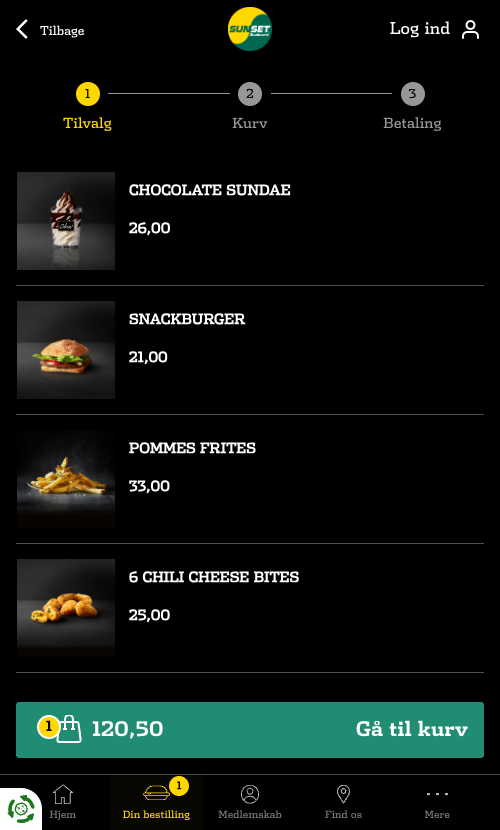
The add-on step in the Sunset Boulevard shop, before the basket
The add-on step in the live Sunset Boulevard shop.
Reported in the Sunset Boulevard case
2% → ~80%
of orders received digitally
~20%
larger basket on digital orders than on manually taken orders

Most chains use both

This is not either-or. Carl's Jr. Denmark runs its own ordering app on FastFoodShop, and its website also links to Wolt for delivery to the door.

Before FastFoodShop, Sunset Boulevard sold digitally through its own web shop and take-away portals, and that was 2% of orders. Its growth came from its own channels: web, app and kiosk.

A sensible split: let the marketplaces bring new guests and do the driving. Give every guest who comes to you a reason to order directly next time: points, a subscription, a faster pickup.

Which to pick

If most of your orders are deliveries to people who have never eaten with you, a marketplace does work you cannot easily do yourself. Keep it.

If you have restaurants with regulars, pickup and eat-in guests, and a brand people look for, your own branded platform should carry those orders. That is where FastFoodShop fits.

If you run both, the question is not which to keep. It is how to move the guests who already know you to the channel you own.

Frequently asked questions

What chains ask when they weigh their own platform against the marketplaces.

Should we leave the delivery marketplaces?+

Not necessarily. Marketplaces are good at reach and delivery. Many chains stay listed and build their own channels next to them. Carl's Jr. Denmark does exactly that.

What do the marketplaces charge?+

A commission on each order. The rate depends on the marketplace, the market and your contract, so we do not quote one here. Your own contract is the figure to use when you compare.

Can FastFoodShop handle delivery?+

Delivery is one of the order types FastFoodShop supports, next to takeaway, eat-in, curbside, drive-in and drive-through. Each chain switches on the ones it needs. FastFoodShop is not a courier service, so talk to us about how delivery would work for you.

How do we move guests from the marketplace to our own channel?+

Give them a reason. Points on every order, a free meal on sign-up, punch cards, or a paid subscription with a discount. At the kiosk, the receipt carries a QR code that invites the guest to join your loyalty program.

Does our own channel work inside the restaurant too?+

Yes. The same platform drives the web shop, the app and the self-service kiosk. In the Sunset Boulevard case, 85% of in-restaurant orders (excluding drive-in) are reported to come from the kiosk or the app.

Do orders from our own channels reach the kitchen like counter orders?+

Yes. Every order lands in your POS, structured as the kitchen needs it: bun, protein, fries, drink, add-ons and removals, with a short order number.

Are Just Eat and Wolt white-label ordering platforms?+

No. They are marketplaces: the guest orders in their app, under their brand, next to other restaurants. A white-label platform such as FastFoodShop puts your brand on the web shop, the app and the kiosk, and you decide how they work.

Weighing a build of your own instead?

FastFoodShop vs building in-house →

See what your own channels could look like

We will show you the live shops of Sunset Boulevard and Carl's Jr. and talk through how the marketplaces fit next to them.

Get in touch

Or email us directly at foodshop-sales@sprintingretail.com