Day One: 60% of Guests Chose the Kiosk
Sunset Boulevard is Denmark's leading Danish-owned fast food chain, with 45+ restaurants and an international expansion under way. Before its digital programme, digital sales were 2% of revenue. The case puts it plainly: “98% of orders were taken manually at the cash registry and drive-in.”
The plan had three phases: kiosk first, then app, then a new web shop. Covid-19 changed the order. During the lockdown the app went live first, so Sunset could offer digital ordering and curbside pickup. The kiosks followed.
They were piloted in two restaurants. On the first day, 60% of the in-restaurant guests used the kiosks. Given the choice, most guests walked past the counter.
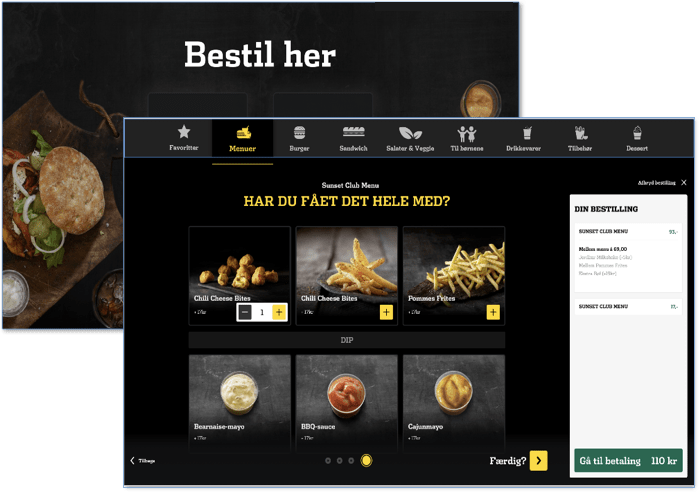
After the Pilot: 85% Self-service Inside the Restaurant
Later, as reported in the case, inside the restaurant (excluding drive-in) 85% of orders are self-service, by kiosk or app, and 15% are taken at the counter. Across all channels, the share of orders placed digitally went from 2% to almost 80%.
“We have gone from only 2% of our orders being received digitally to almost 80% in total.”
The same case reports that digital orders are about 20% larger per transactionthan orders taken manually, and that “the payback has far exceeded our expectations.” We look at where the larger basket comes from in Why Digital Orders Are Bigger. The full story is in the Sunset Boulevard case study.
What Outside Figures Say
Sunset's numbers are one chain's. Two figures from outside, quoted in Sprinting Retail's post on digital food ordering, point the same way. Neither is a FoodShop result.
- Tillster survey: 60% of respondents said they would visit a restaurant more often if it had self-service kiosks.
- McDonald's: guests spend 30% more when they order at a kiosk.
The same post gives two reasons kiosks work. They take load off the counter at rush hour. And they lead to larger purchases, because “some people do not like to be upsold by a person”.
Lessons From the Rollout
1. Pilot in a few restaurants, then roll out. Sunset started with two restaurants, and the first day already showed how guests responded: 60% used the kiosks.
2. Launch and learn.When Covid-19 made the kiosk the wrong first step, Sunset launched the app first and kept going. In Cathrine Florian Bang's words: “Launch and learn. Do not stand still.” She also named “the agile approach and focus on short development cycles” as a reason for choosing Sprinting Retail: “We are impatient by nature and want a short time from idea to launch.”
3. Run every channel from one place.Sprinting Retail's post argues for one platform behind all channels: add a product once and it appears in the web shop, the app and the kiosk. On FastFoodShop the kiosk is a channel of the same shop as the app and web shop, managed from the same back office.
4. Send kiosk orders straight to the POS.A kiosk order has to reach the kitchen the same way a counter order does. FastFoodShop sends every order into the restaurant's POS, structured as the kitchen needs it: bun, protein, fries, drink, add-ons, removals.
5. Link the kiosk to loyalty. On FastFoodShop, app users can log in at the kiosk by scanning a QR code from the app, and kiosk receipts carry a QR code that invites guests to join the loyalty programme.
6. Keep the counter. At 85% self-service, 15% of in-restaurant orders still went through the counter at Sunset. The kiosk takes most of the volume; it does not take all of it.
A Checklist Before the First Kiosk
- Pick two restaurants for a pilot and measure the kiosk share from day one.
- Manage kiosk, app and web shop menus from one back office.
- Make sure kiosk orders land in the POS exactly as counter orders do.
- Give app users a way to log in at the kiosk, and invite everyone else to join loyalty.
- Decide what the counter is for once most guests order themselves.
Facts and quotes about Sunset Boulevard are from the published Sunset Boulevard customer story by Sprinting Retail, the company that develops FoodShop, and refer to the period the case describes. The Tillster and McDonald's figures are as quoted in Sprinting Retail's post How to Fuel Food Sales with a Powerful Digital Food Ordering System; they belong to their sources, not to FoodShop.